
Reviewed · INCA RUINS & ARCHAEOLOGY
Horseback Riding Plus Tour to Sacsayhuaman, Quenqo, Puka Pucara and Tambomachay
Mountain views and Inca ruins make a fine pairing. This four-hour Cusco outing combines visits to Sacsayhuaman, Qenqo, Puka Pukara, and Tambomachay with about an hour to an hour and a half on horseback. I like the mix of history and fresh air, and I like that private transport links the sites so you do not spend the whole morning walking between them. The main catch is that horseback riding is only one part of the tour, not the main activity, and the archaeological entrance ticket costs extra.
The riding suits beginners, with horses matched to each rider’s confidence and a muleteer caring for the animals. Guides such as Benni, Benny, Jenny, and Hogler have earned praise for clear explanations and thoughtful pacing. Still, you should bring sun protection, allow for a possible rain shower, and confirm the snack arrangement, since one past participant did not receive the snack described.
In This Review
- Key points to know before booking
- Four Inca sites, one horseback outing
- Sacsayhuaman, Cusco’s great stone fortress
- Puka Pukara and the old road system
- Tambomachay and water in the hills
- Qenqo and the ceremonial side of Cusco
- The Vieja Estancia Ranch and the ride
- What the guide adds to the day
- Is $95 good value?
- Clothing, safety, and altitude
- Who should book this Cusco tour?
- Should you book it?
- FAQ
- How long does the tour last?
- How long is the horseback ride?
- Which archaeological sites are included?
- Can beginners join the horseback ride?
- What is the minimum age?
- Is there a weight limit?
- Are the archaeological entrance fees included?
- What should I wear?
- Are helmets and horse equipment provided?
- Does the tour include transport?
Key points to know before booking
- Four major Inca sites in about four hours: Sacsayhuaman, Qenqo, Puka Pukara, and Tambomachay are covered in one compact outing.
- Horseback riding lasts about one to one and a half hours: The ride takes place around the Cusco hills, not directly through the protected archaeological sites.
- A good first ride for beginners: The horses are matched to experience, and the riding guide adjusts the pace to the least experienced person.
- Strong guiding is a major part of the value: Benni, Benny, Jenny, and Hogler are praised for clear, engaging explanations of Inca history and customs.
- The $95 price does not include site admission: Set aside extra money for the Cusco Tourist Ticket or the required archaeological-site entrance.
- Plan for mountain weather: Wear long trousers and closed shoes, use sunscreen even on cloudy days, and carry a rain jacket when rain is possible.
Four Inca sites, one horseback outing
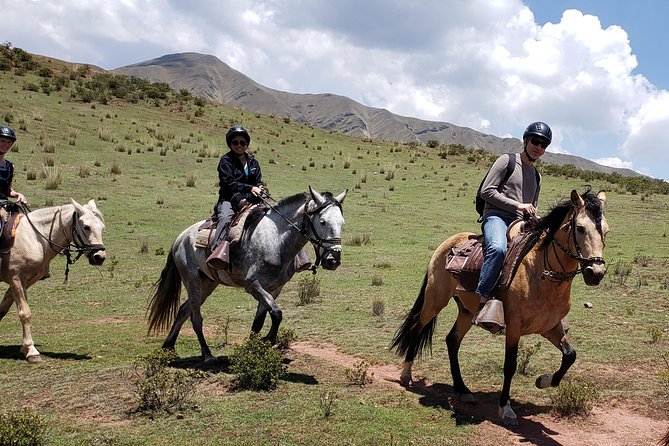
This tour works because it joins two very different Cusco experiences. You get a guided look at important Inca sacred and defensive sites, then spend time outside the city on horseback, with broad views of the mountains near the old Inca capital.
The private car handles the transfers. That matters here. The sites are spread around the hills above Cusco, and trying to connect them on foot would waste much of your half-day. You also avoid the fuss of arranging separate taxis between stops.
The order can vary, but the planned stops include Sacsayhuaman, Puka Pukara, Tambomachay, the Vieja Estancia Ranch, and Qenqo. The archaeological sites are visited on foot. Horses are not taken over the ruins, since their hooves could damage the ground and protected remains.
That point is worth making clear before you reserve. The title may suggest a long ride from one ruin to another, but the riding is a separate section of the day. Most of the tour involves driving and walking through the sites. If your priority is a full morning in the saddle, this is not that tour. If you want an easy ride added to a well-organized introduction to Cusco’s nearby ruins, it makes more sense.
More Horses in Cusco
- Cusco: 3-Hour Horse Riding Tour to the Temple of the Moon
★ 5.0 · 105 reviews - Cusco: Half-Day Horseback Riding at Devil’s Balcony
★ 4.9 · 89 reviews - Horse Riding Chacan Mountain And Temple Of The Moon
★ 5.0 · 78 reviews
Sacsayhuaman, Cusco’s great stone fortress
Sacsayhuaman is usually the biggest visual hit. Massive fitted stones form the famous zigzag walls, and the site gives you a strong sense of the scale and skill behind Inca construction.
Your guide explains the site’s role, its stonework, and the religious customs tied to the Inca world. This is where a good guide matters most. The stones are impressive on their own, but clear context helps you understand why the site was so important and how it related to Cusco below.
You will walk around the archaeological area rather than ride through it. Wear shoes with a solid sole, since the ground can be uneven. At Cusco’s altitude, a short walk can feel more demanding than the distance suggests, so take your time and keep water close.
Sacsayhuaman is also one of the better places on this route for views over the city and surrounding mountains. Bring a camera, but do not let it distract you from the stonework. The scale is difficult to appreciate through a screen.
Puka Pukara and the old road system
Puka Pukara has a different character from Sacsayhuaman. Its name is often translated as Red Fortress, and its position near the old route out of Cusco helps explain its practical importance.
The site is smaller and easier to cover in a short visit. Your guide ties the remains to travel, control, and the wider Inca network. That makes Puka Pukara a useful contrast with Sacsayhuaman, where the huge walls tend to dominate your attention.
You should expect a guided stop rather than a long independent exploration. The benefit is efficiency. In a four-hour tour, you can see several places without having to decode each one alone. The tradeoff is that you will not have unlimited time at any single site.
Tambomachay and water in the hills
Tambomachay is linked with water and ceremonial use. Channels and stonework give the site a quieter feel than Sacsayhuaman, and your guide discusses the religious customs and engineering ideas connected with it.
This stop rewards careful looking. The water features are not as dramatic as the giant walls at Sacsayhuaman, but they show another side of Inca planning. The Incas worked with the natural slope and water supply in ways that were both practical and ceremonial.
The stops at Puka Pukara and Tambomachay also help break up the riding portion. You are not expected to spend four straight hours on horseback, which is useful if you have little riding experience or are still adjusting to Cusco’s altitude.
More Inca Ruins & Archaeology in Cusco
- Cusco: Half-Day City Tour with Sacsayhuaman and Q’enco
★ 4.6 · 1,129 reviews - City Tour Cusco Qoricancha Sacsayhuaman y Tambomachay
★ 4.7 · 617 reviews - Cusco City Sightseeing, San Pedro Market, Cathedral and Qorikancha Temple
★ 4.5 · 139 reviews - Cusco City Sightseeing and Sacsayhuaman Archeological Park Tour
★ 4.5 · 101 reviews
Qenqo and the ceremonial side of Cusco
Qenqo adds another religious and archaeological layer to the route. The site is associated with carved stone, ceremonial spaces, and customs that your guide will explain as you move through it.
As with the other ruins, the details can be easy to miss without help. The guide’s role is not just to name the site, but to connect its stone features with the beliefs and practices of the Inca civilization.
Qenqo is included as one of the four principal archaeological visits, but the exact amount of time at each place depends on the day’s pace and transport. This is a highlights tour, not a slow archaeological study. You get a broad introduction rather than a long, quiet session at every site.
The Vieja Estancia Ranch and the ride
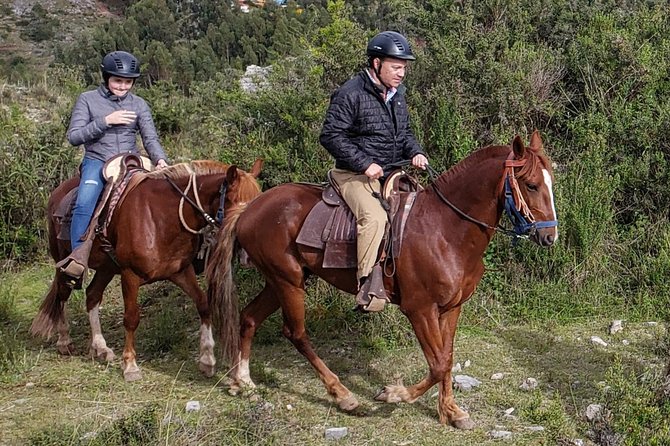
The horseback portion takes place at the Vieja Estancia Ranch. You receive a saddle and safety helmet, and a muleteer goes along to care for the horses. That extra horse-care support is reassuring, especially for first-time riders and families.
The horses are matched to the rider’s experience and confidence. The guide keeps the group moving at the pace of the least experienced rider, while more confident riders may get the chance to stretch their legs and ride faster when conditions allow. One experienced rider even described being able to open up the pace a little, while a newer rider in the same group felt secure.
That balance is one of the tour’s strongest features. Beginners are not pushed into a difficult ride, yet experienced riders are not necessarily stuck walking the entire way. The route is described as easy to moderate, with mountain views, sheep fields, and smaller ruins visible around the riding area.
Expect roughly one hour of riding in some departures, and about an hour and a half in others. The supplied details are not perfectly consistent, so you should plan around one hour rather than assume most of the four-hour tour will be on horseback.
Peruvian horses are praised for a comfortable gait. That can make a real difference on an introductory ride. You still need to wear suitable clothing, since even a gentle ride can rub your legs or leave you dusty.
What the guide adds to the day
The guiding is one of the main reasons this tour receives such strong praise. Benni is singled out for answering questions clearly, even when the questions were not perfectly phrased. Benny is also praised for making the day personal and easy to follow, while Jenny and Hogler are noted for strong explanations of Inca history, architecture, and culture.
The useful quality here is not simply the amount of information. A guide who can explain complicated ideas in plain English makes the ruins easier to understand. You can ask why a wall was built, how a site was used, or what a particular ceremony meant, rather than just walk past stones with a few names attached.
The experience also seems to benefit from a small local operation. The provider describes a team that includes the guide, driver, riding guide, and muleteer. A group can include up to 15 people, so it is not necessarily private at the ruins, but the car transport and horse handling add structure to the day.
If your assigned guide is Benni, Benny, Jenny, or Hogler, you can expect a strong focus on questions and explanation based on the praise attached to those guides. Guide assignments can vary, so treat the names as examples rather than a guarantee.
Is $95 good value?
At $95 per person, this is not the cheapest way to see the four sites. The price does cover professional guiding, private-car transport, saddle, helmet, muleteer support, and mineral or natural water.
The value depends on what you would otherwise arrange yourself. Separate taxis, site visits, a riding session, and a guide could take more planning and may not cost less once everything is added. The private transport is especially useful because the archaeological sites are scattered around Cusco.
The entrance ticket is not included, and that extra cost needs to be part of your calculation. The provider explains that the archaeological sites are managed by the Peruvian government and that admission costs around $20, although the exact charge can depend on the ticket required. One past participant referred to a 70 soles fee, so confirm the current amount before departure.
Snacks are listed among the highlights, but the inclusions specify water rather than a detailed snack provision. One participant reported not receiving snacks. I would bring a small personal snack and treat any included food as a bonus.
The cost also reflects horse care. Well-behaved horses, transport, a riding guide, a professional history guide, and a muleteer require more staff than a simple walking tour. That does not make the price automatically right for everyone, but it explains why this is not priced like a basic city excursion.
Clothing, safety, and altitude
Wear long trousers, preferably jeans, and closed shoes with rubber soles or walking shoes. Avoid jewelry and valuables during the ride. A rain jacket is sensible whenever the forecast shows a real chance of rain.
Use sunscreen even if the sky is cloudy. One participant specifically regretted skipping it on an overcast day. The high altitude and strong mountain sun can catch you off guard.
The tour is designed for people with little or no riding experience, and the minimum age is six. The maximum weight is 200 pounds, or 90 kilograms. Most people can participate, but you should be comfortable mounting a horse, sitting in the saddle, and walking around archaeological sites.
A first-aid kit is carried by the guide for emergencies. The guide is not authorized to provide medication outside the limits of first aid, so bring any personal medication you may need.
The tour requires good weather. If poor weather forces cancellation, you receive the option of another date or a full refund. You can cancel for a full refund up to 24 hours before the start time. Inside that window, refunds and changes are not accepted.
Who should book this Cusco tour?
I would choose this outing if you want a half-day introduction to Cusco’s nearby ruins with an outdoor activity added. It suits couples, families with older children and teens, solo visitors, and first-time riders who want something more active than a standard van tour.
It is also a good choice if you want a guide to explain the sites instead of simply taking photographs and moving on. The combination of Sacsayhuaman’s giant walls, Tambomachay’s water features, Qenqo’s ceremonial setting, and Puka Pukara’s route-side position gives you a useful spread of Inca architecture and customs.
I would hesitate if you want several hours of riding, a fast trail ride, or a completely private archaeological visit. The riding is limited, the pace follows the least experienced rider, and the entrance fee is extra.
Should you book it?
Book this tour if you value clear cultural explanation, mountain scenery, and a gentle horseback ride in the same morning. The horses are matched carefully, the route suits beginners, and the guides receive unusually strong praise for making Inca history understandable.
Skip it if riding is your main goal. For everyone else, the $95 price can be fair once you account for transport, staff, equipment, and guiding, but remember to budget for the archaeological ticket and bring your own snack. For a compact Cusco outing that mixes ruins with time outdoors, this is a well-balanced pick.
FAQ
How long does the tour last?
The tour lasts approximately four hours.
How long is the horseback ride?
The horseback ride is generally about one hour to one and a half hours. The rest of the tour involves transport and visits to the archaeological sites.
Which archaeological sites are included?
The tour includes Sacsayhuaman, Qenqo, Puka Pukara, and Tambomachay.
Can beginners join the horseback ride?
Yes. The tour is suitable for people with little or no horseback-riding experience, and the horses are matched to each rider’s experience and confidence.
What is the minimum age?
The minimum age is six years old.
Is there a weight limit?
Yes. The maximum weight is 200 pounds, or 90 kilograms.
Are the archaeological entrance fees included?
No. The Cusco Tourist Ticket or archaeological-site entrance fee is not included and must be paid separately.
What should I wear?
Wear long trousers, preferably jeans, along with closed shoes with rubber soles or walking shoes. Bring a rain jacket if rain is possible.
Are helmets and horse equipment provided?
Yes. The tour includes a saddle and safety helmet.
Does the tour include transport?
Yes. Transport by private car from hotels and back is included.
More Rides on Horseback
- Horseback Tour in cusco to Temple of the Moon & Hidden temples
★ 5.0 · 54 reviews - Half day Horseback Riding tour around Sacsayhuaman park
★ 5.0 · 37 reviews - Cusco: Rainbow Mountain Horseback Riding Tour + lunch
★ 4.1 · 10 reviews - Rainbow mountain horseback riding tour + Buffet Lunch
★ 3.8 · 9 reviews
More Inca Sites and Ruins
- Cusco: Historical Guided City Tour with 4 Inca Ruins
★ 4.5 · 99 reviews - Cusco 4-Hour Private Tour Including Sacsayhuaman and Qenqo
★ 5.0 · 77 reviews - Half-Day City Tour of Cusco Including Tambomachay
★ 4.5 · 59 reviews - Sacsayhuaman Temple, Tambomachay and Puca Pucara Half-Day Tour
★ 4.5 · 59 reviews
Just added around Cusco
- Cusco: Rainbow Mountain and viewpoint red valley ( optional)★ 4.8 · 3 reviews
- Montaña de Colores: tour en cuatrimotos día completo★ 3.3 · 3 reviews
- Tour Pallay Punchu Trek Full Day★ 4.2 · 3 reviews
- Excursion Cusco – Puno – Titicaca Observatory Train★ 5.0 · 3 reviews
- Maras Moray★ 5.0 · 3 reviews
- Cusco: Palcoyo Mountain Day Trip with Breakfast and Lunch★ 4.8 · 3 reviews
- Tour to Laguna Humantay with breakfast and lunch from Cusco★ 4.7 · 3 reviews
- From Cusco:Chinchero, Moray, Maras, Ollantaytambo with lunch★ 5.0 · 3 reviews
Inca Ruins & Archaeology, compared.

Half-Day City Tour with Sacsayhuaman and Q’enco
Read our review →
City Tour Cusco Qoricancha Sacsayhuaman y Tambomachay
Read our review →
The Charm of Barranco & Pre Inca Pyramid in Miraflores
Read our review →
Pachacamac Ruins & Barranco Half-Day Guided Tour
Read our review →
Pre Inca Temple of Pachacamac Half-Day Tour from Lima
Read our review →

Cusco City Sightseeing, San Pedro Market, Cathedral and Qorikancha Temple
Read our review →
3-Hour Horse Riding Tour to the Temple of the Moon
Read our review →Browse the lists this tour appears in